

Reviewed · CARDIFF BAY TOURS
Cardiff Bay Private Self-Guided Tour
Cardiff Bay tells a story on foot. This self-guided walk uses Helen’s audio guide to stitch together wetlands, dock history, and famous landmarks across about 3 hours. You move at your own speed, but the app keeps you pointed at the details you’d otherwise miss.
I especially like the easy-to-follow route with map, directions, and a GPS track that makes it feel simple even if it’s your first time in the bay. A possible drawback is that this is very much phone-led, so plan to keep your battery charged and your attention on the screen at each stop.
In This Review
- Key Highlights You’ll Feel as You Walk
- Cardiff Bay in 3 Hours, Starting at the Penarth Barrage
- Stop 1: Cardiff Bay Wetland Reserve, 8 Hectares of Breathing Space
- St David’s Hotel, a Landmark You’ll Notice More Than Once
- Techniquest (Since 1986), Science Made for Real Breaks
- Mount Stuart Graving Docks to Mermaid Quay, Where the Waterfront Turns Playful
- The Boardwalk and Ianto’s Shrine Under Mermaid Quay
- Roald Dahl Plass, Then the Wales Millennium Centre at the Bay’s Arts Core
- Pierhead Building and the Senedd, Cardiff at Official Status
- Norwegian Church Arts Centre and the Multicultural Memory of Tiger Bay
- Roath Basin and Roath Dock: Reading the Water Behind the View
- Cardiff Bay Barrage, the Water Regulator You Can Actually Walk On
- Locks, Sluice Gates, Fish Pass, and the Control Room Moment
- Price and Value at About $12.22 Per Person
- Pace, Distance, and Who This Tour Fits Best
- Should You Book This Cardiff Bay Self-Guided Tour?
Key Highlights You’ll Feel as You Walk
- Helen’s audio guide (no computer voice) keeps the route lively and human.
- Free stops throughout the route, so you spend money on meals, not tickets.
- A walk you can stretch out, since it’s designed for breaks and short photo moments.
- Top-to-bottom sightseeing, from building façades to ground-level details.
- Family-friendly pacing, with short, readable stops along the way.
More around the barrage and the bay:



Cardiff Bay in 3 Hours, Starting at the Penarth Barrage

This experience is built for one clear goal, help you see Cardiff Bay like an insider without locking you into a group schedule. You start at the Barrage in Penarth, then wind your way across the bay landmarks until you finish on the Cardiff Bay Trail. Plan on around 3 hours, and in practice the walking distance is about 4 km if you keep pauses sensible.
The tone is practical. The app gives you a map, GPS route, and step-by-step stop guidance, so you can just follow along instead of trying to figure out which pier is which. And because you get videos, pictures, and recommendations, you’re not only walking past places, you’re getting context fast.
One more thing I like: you have unlimited access for 3 weeks. That means you can replay sections later, or go back for a second look without paying again.
Stop 1: Cardiff Bay Wetland Reserve, 8 Hectares of Breathing Space
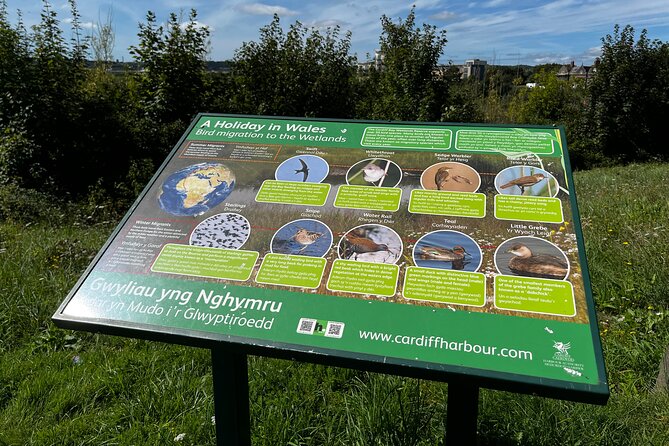
Your tour begins near the waterworks thinking, then immediately shifts to nature thinking at the Cardiff Bay Wetland Reserve. It covers about 8 hectares north of the bay, and it exists because of a specific loss during redevelopment, the Taff-Ely Site of Special Scientific Interest was removed. This reserve was created in response, which gives you a clear reason to pay attention to a place you might otherwise treat like a simple green strip.
It’s a good first stop because it sets the right mindset. Cardiff Bay is not only buildings and boats. It’s engineered water, wildlife habitat, and redevelopment history all mixed together.
Admission is free here, so it’s a low-commitment way to get oriented. If your group is moving at different speeds, the reserve also works well for a quick regroup, since there’s room to pause and spread out.
St David’s Hotel, a Landmark You’ll Notice More Than Once
From the wetlands, you’ll hit one of those places you can see from almost anywhere in the bay, St David’s hotel. The tour frames it as a major landmark built as part of the bay redevelopment, so even if you’ve passed it before, it becomes part of the story rather than just a background building.
This is the kind of stop I love in a self-guided format. When the app explains why a structure was placed where it is, you start looking at sightlines. You’ll notice how the hotel’s presence helps you measure distance and direction across the water.
Techniquest (Since 1986), Science Made for Real Breaks
Next up is Techniquest, the UK’s longest-established science discovery centre. The fact it opened in 1986 matters, because it signals that Cardiff Bay has been investing in family-friendly learning for decades, not just adding attractions in the last few years.
Even if you don’t plan to spend a long time inside, this stop is a solid break point. Science centres are often best experienced in short bursts, and the app context makes it easier to decide whether you want to add extra time.
Admission is free for the tour stop itself, so you’re not gambling much by taking a closer look.
Routes you take at your own pace:
- Llanberis, Conwy and Caernarfon Castle: A Self-Guided Driving Tour of Snowdonia
★ 4.5 · 5 reviews - Wales’ West Coast – Online Self-Guided Road Trip Plan
★ 5.0 · 1 review - Llandaff’s Ghosts: A Self-Guided Audio Tour
★ 4.5 · 29 reviews - Doctor Who and Cinematic Cardiff: Self Guided Walking Tour
★ 5.0 · 12 reviews - Cardiff’s Bay and Waterfront: A Self-Guided Audio Tour
★ 4.5 · 11 reviews
Mount Stuart Graving Docks to Mermaid Quay, Where the Waterfront Turns Playful

As you move along the docks side, the tour switches into shipyard history. Mount Stuart Graving Docks were built by the Marquesses of Bute, tied to their ancestral home, Mount Stuart on the Isle of Bute in Scotland. That’s a neat connection, because it reminds you that big projects around the bay weren’t random. They were linked to people with money, land, and long-term influence.
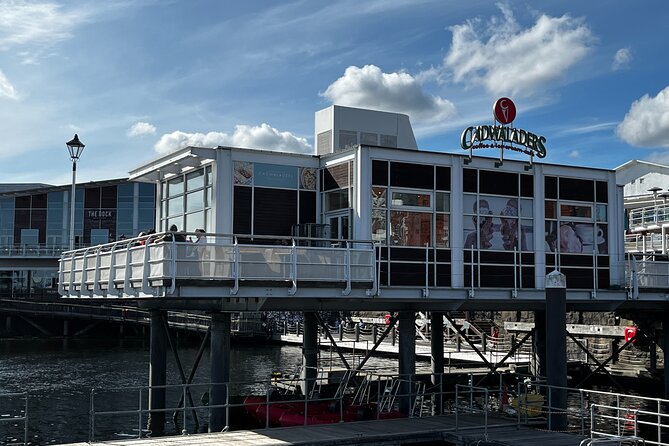
Then you reach Mermaid Quay, a mixed land-use waterfront development that opened in 1999. The big headline is scale: it has over 30 restaurants, bars, and cafés. Add a comedy club, a 5-screen boutique cinema, and shops, and you get a place that naturally supports a full day, even if your walking part is only a few hours.
Here’s the practical value. When you finish your walking legs, Mermaid Quay gives you options without needing transportation planning. It’s also an easy place for different groups in your party to make different choices, food people, show people, and just-walk-it-off people.
The Boardwalk and Ianto’s Shrine Under Mermaid Quay
Below Mermaid Quay runs a boardwalk, and this is where the bay gets more playful and slightly surreal. On the western side sits Ianto’s Shrine, a memorial to a man who never existed.
That’s not the kind of detail you guess from a waterfront view. The tour helps you notice the boardwalk level and directs your attention so you don’t miss the small stories hiding under the main attractions.
If you like quirky local culture, this stop is a payoff. If your group prefers straightforward landmarks only, you might skim it quickly, but it still makes the route memorable.
Roald Dahl Plass, Then the Wales Millennium Centre at the Bay’s Arts Core

Roald Dahl Plass is an old dockyard entrance, where ships would have passed beneath the footbridge now in place. That single detail turns a modern footbridge into a time machine. Instead of seeing it as a crossing point, you see it as a marker of how the port used to function.
At the end of Roald Dahl Plass is the Wales Millennium Centre, Wales’s national arts centre. It’s home to eight cultural organisations, including the Welsh National Opera and BBC NOW. Even if you don’t watch a performance, the building itself is worth treating as a landmark you can navigate by.
Why this matters on a self-guided walk: arts venues often feel intimidating if you only think about ticketed events. Here, the app framing makes it more approachable, like a civic centerpiece rather than an optional extra.
Pierhead Building and the Senedd, Cardiff at Official Status

Keep going and you’ll reach two Cardiff power symbols.
First is the Grade I listed Pierhead Building, once the headquarters of the Cardiff Railway Company. The “Grade I listed” label tells you it’s protected, but the tour gives you a clearer story: it was tied directly to how goods and people moved, the infrastructure behind industrial Cardiff.
Then comes the Senedd, the iconic home of the Welsh Parliament in Cardiff Bay. This stop is great for photos, but more importantly it gives you a sense of how the bay has transformed from working docks into a modern civic and cultural space.
If you’re walking with kids, this is the part where explanations stick. A parliament building and a theatre in the same bay makes it feel like the city is showing off its identity.
Norwegian Church Arts Centre and the Multicultural Memory of Tiger Bay
At Norwegian Church Arts Centre, the tour shifts into community history. It points out how, like many British docks, Tiger Bay became a multi-cultural hub where migrants from all over the world mingled and formed communities.
This stop can be emotionally different from the landmark stops. It asks you to consider the human side of port life: the arrivals, the mixing, the networks that grew around ships and jobs.
Even with no long museum visit, the app context helps you see the building as part of that larger web, not just as an arts venue in a modern bay.
Roath Basin and Roath Dock: Reading the Water Behind the View
As the route continues, Roath Basin becomes your visual anchor. The bridge you can see from the area spans the entrance to Roath Basin and Roath Dock. Roath Basin is the lake right beyond the bridge, and it provides access to Roath Dock further beyond that.
This is a clever kind of stop for a self-guided format. You’re not only told what’s there. You’re given a way to interpret it from where you stand. You start reading the water layout, and suddenly the bay looks like a system rather than random scenery.
Admission is free for this stop, and it works well if your party has energy limits. Even a quick check-in here gives a satisfying “oh, that’s what I’m looking at” moment.
Cardiff Bay Barrage, the Water Regulator You Can Actually Walk On
Now you hit the bay’s engineering showpiece. You’re standing on the Cardiff Bay Barrage, constructed to maintain the water level in the bay. The tour adds a standout detail about how the inland waterway is kept aerated by 20 km of pipes and 6,000 air diffusers on the floor of the bay.
That kind of detail changes how you see the structure. It’s not just a wall or a boundary. It’s an active system that keeps water conditions stable enough for life and activity in the bay.
This is also a strong place to slow down. The viewing platform and a permanent exhibition give you a chance to look around without feeling like you’re rushing.
Locks, Sluice Gates, Fish Pass, and the Control Room Moment
On the barrage area, the tour gets more hands-on in description. You’ll see locks and bridges, sluice gates, and a fish pass. The locks keep the bay at permanent high water, and there’s a control room you should be able to spot high up to the left as you approach lock number 1.
The stop also explains the protective walls. There are two harbour walls that defend the entrance to the locks from high tides and bad weather in the Bristol Channel. It’s a reminder that this is coastal engineering, designed with the wider ocean in mind.
On the Penarth side, the tour points out two imposing buildings: the Marine building to the left and the Old Custom House to the right. Even if you’re not a history buff, these are good orientation markers. They help you map where you started and where you ended your walk.
Price and Value at About $12.22 Per Person
At $12.22 per person, you’re not buying a guided lecture. You’re buying an app-based route with a lot of built-in explanation. The big value points are:
- 3 weeks of unlimited access, so you can redo sections.
- GPS map, directions, and stop guidance, so you don’t spend your time lost.
- Helen’s audio guide with videos and pictures, so you get context without staring at signage.
- Multiple stops with free admissions, meaning you can spend your money on food, not tickets.
It’s also good value if you like to pause. This kind of walk rewards people who stop for details, not people who only want fast photo ops.
Pace, Distance, and Who This Tour Fits Best
This is built for flexible timing. Expect about 3 hours, and a walk around 4 km if you don’t rush. The self-guided format is ideal if your group includes mixed interests, because each stop can be a quick glance or a deeper moment depending on your mood.
Based on the experience’s design, it’s a strong fit for:
- families who want short, child-friendly stops
- couples who enjoy walking and learning at a comfortable pace
- anyone who’s visited the bay before but wants a better story and sharper sightlines
A quick practical note: this is near public transportation, which helps if you plan to finish and keep exploring beyond the Cardiff Bay Trail. And because it’s described as working for most travelers, it’s a good choice when you want low friction planning.
Should You Book This Cardiff Bay Self-Guided Tour?
Book it if you want a low-cost, high-context way to see Cardiff Bay in a few hours. Helen’s audio guide, the GPS route, and the mix of wetlands, docks, arts buildings, and engineering details make it easy to feel like you’re getting more than just a scenic walk.
Skip it if you hate app-based guidance, or if you prefer a live person who can answer questions on the fly. If that’s you, you might get more satisfaction from a traditional guided tour instead.
If you do book, do one thing before you start: read the app’s Before you go section in your confirmation email. It helps you get your bearings fast, so the first stops feel welcoming, not confusing.
Lately added in Wales



Cardiff Bay Tours, compared.


Private Day Tour of Cardiff, including Cardiff Castle, St Fagans, & Cardiff Bay
Read our review →
Sightseeing Tour Cardiff Bay and Vale of Glamorgan Full-Day Driver Guided
Read our review →

Cardiff Bay Quest: Self Guided Walk & Immersive Treasure Hunt
Read our review →Browse the lists this tour appears in